Curatorial Note
Tensing Joseph, Visual Artist
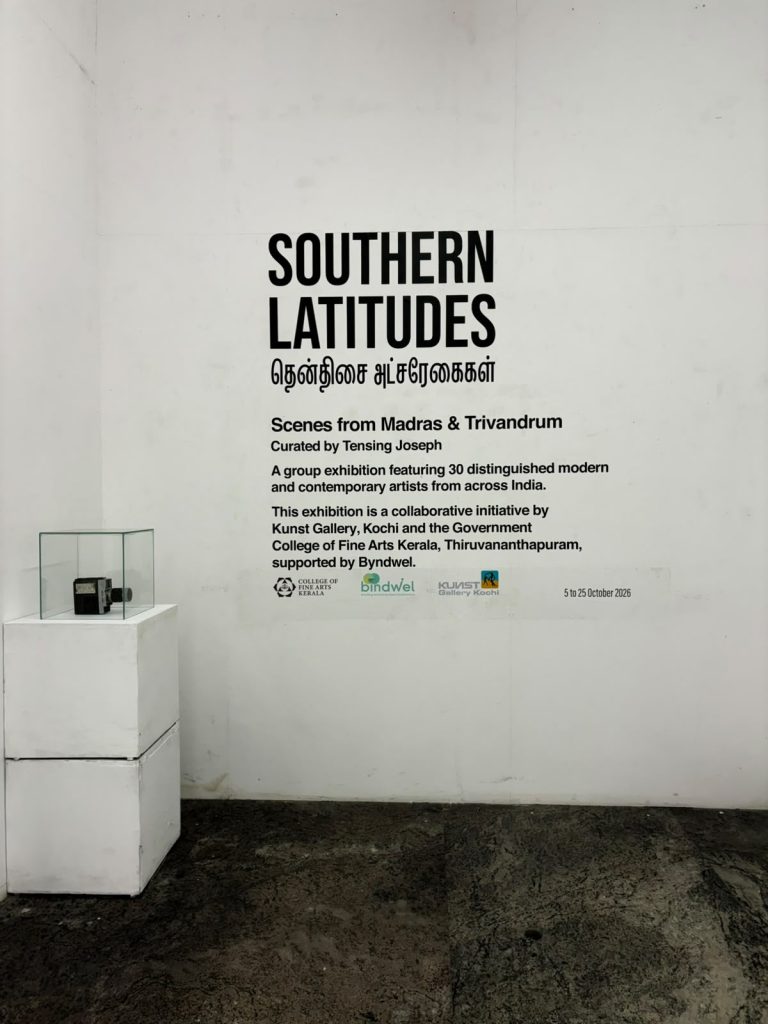
The exhibition ‘Southern Latitudes’, Scenes from Madras and Trivandrum hosted at the College of Fine Arts, Thiruvananthapuram, brings together thirty nationally acclaimed artists. We believe this exhibition holds contemporary relevance and offers an opportunity to re-visiting art through a historical perspective. It explores the evolution of South Indian modern art, specifically focusing on the nature of Modernism as it emerged in Kerala during the 1970s and 1980s. Last year, an exhibition titled ‘Palette of Legacies’, featuring fifteen renowned South Indian artists at the Kunst Gallery in Kochi, garnered significant attention from art community. Following that success, the concept emerged to curate a more expansive, academically rigorous, and intellectually enriching exhibition that includes a larger number of artists from Kerala. Alongside over a hundred artworks, including sculptures by thirty prominent Indian artists, the exhibition incorporates archival materials such as rare photographs, letters, sketchbooks, and newspaper clippings collected over time. We hope viewers will perceive this exhibition as an opportunity to understand how artists of the 70s and 80s viewed the relationship between art and life, and how a distinct regional modernism emerged within the broader context of Indian modern art.
The contributions of figures like M. Govindan and M.V. Devan bear witness to the pivotal role literature played in shaping modernism within Kerala’s visual arts. The College of Fine Arts often served as a forum where literary and cultural figures such as Kadammanitta Ramakrishnan, John Abraham, A. Ayyappan, and Balachandran Chullikkad, discussed the social, cultural, and political issues of the era; indeed, the institution acted as a vital catalyst in the evolution of modern and contemporary art in Kerala. As an art student who participated in the radical Left-leaning artistic and cultural movements of the 80s, my emotional bond with my teachers, South Indian modern and contemporary artists was also a key factor behind organising this exhibition.
Artists such as N.S. Bendre, K.K. Hebbar, and K.M. Adimoolam, who served as visiting professors during the period of C.L Porinchukutty in 80s, played a crucial role in introducing students to modern Indian art. The students of K.C.S Paniker of the Madras College, figures such as A.P Santhanaraj, Kanai Kunhiraman, A.C.K. Raja, and from Baroda R. Nandakumar served as faculty members, others like M.V. Devan and C.N. Karunakaran, operating outside the formal art institution played pivotal roles in shaping the transformations within Kerala’s modern art, literary, and cultural spheres. Student protests in the 1980s, aimed at improving the college’s infrastructure, combined with a strong dissent against antiquated artistic concepts, paved the way for a new perspective on contemporary art education.
This exhibition, which critically examines the legacies of South Indian modern arts, aims to foster dialogue and reflection concerning the artistic practices through which the new generation articulates the identities they seek to define. We believe that artists and art enthusiasts will visit this exhibition with the firm conviction that the appreciation and critique of art involve a continuous process of engaging with ideas embracing some while questioning others.
